
China’s Structural Liquidity Trap Rears Its Ugly Head
The economic situation in China continues to be an unmitigated disaster, with the July Retail Sales, Industrial Production, and Fixed Assets Investment all slowing and missing consensus estimates.
Animal spirits in China are being weighed down by beleaguered private sector balance sheets. With respect to liabilities, China remains one of the most indebted major economies in the world. With respect to assets, China’s property market — the #2 asset for Chinese citizens behind bank deposits — has yet to recover from the beating it took from the 1-2 punch of “Zero COVID” and Emperor Xi’s “Three Red Lines” macroprudential policy.
All told, the Chinese economy is doing exactly what we thought it would do in the absence of large-scale fiscal stimulus — i.e., return to the structural liquidity trap it was mired in prior to COVID.
What Is The Outlook on Inflation?
Earlier this week, Darius joined Anthony Pompliano to discuss Global Liquidity, Inflation, the Housing Market, and more.
In case you missed it, here are five takeaways from the interview every investor needs to see:
1. Global Liquidity Has Been Declining Over The Past Few Months
Our proxy for global liquidity, estimated via central bank balance sheets, broad money supply, and FX reserves minus gold, has been waning over recent months.
Now that we have observed a negative inflection in global liquidity, it is important for investors to ascertain the durability of this nascent trend.
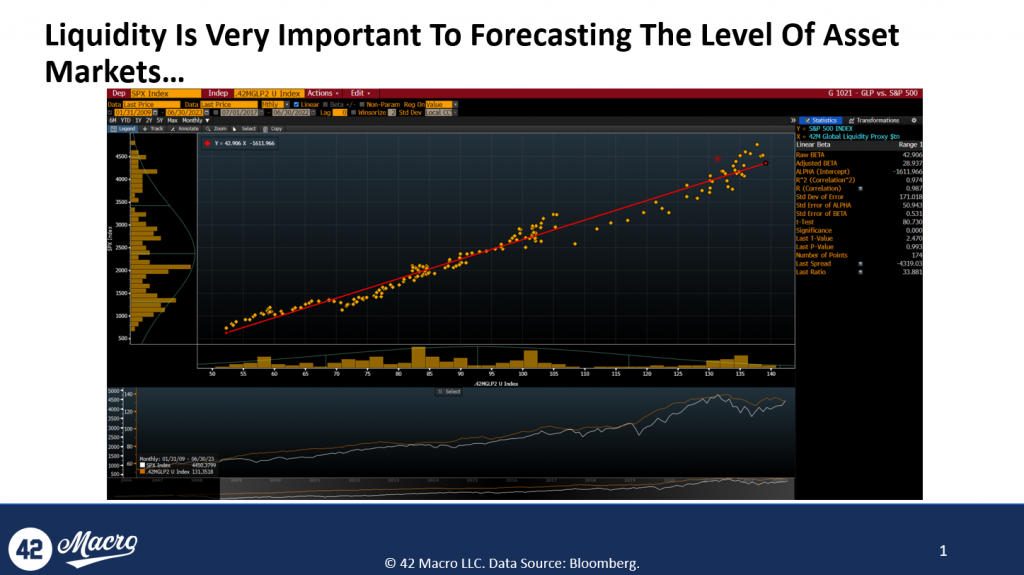
2. Liquidity And Asset Markets Are Correlated On A Levels Basis, But Not On A Rate of Change Basis
The correlation between global liquidity and the S&P500 is substantial on a level basis, explaining 97% of the index’s level since 2009.
However, when regressing global liquidity against the rate of change of the S&P500, there is only a 12% correlation between the two.
When analyzing Bitcoin, we found that liquidity explains 77% of its level but 0% of its rate of change.
So, although liquidity is essential to understanding the long-term trend in asset markets, we should not linearly extrapolate its effects on asset markets in the short to intermediate term.
3. Inflation Will Be The Driver That Causes Asset Markets to Decline
We believe the revival of inflation as an important topic could lead to a downturn in the markets.
Currently, we are seeing favorable inflation outcomes and growth exceeding expectations supporting asset markets.
This dynamic has been beneficial for asset markets in H1, and we believe it will continue through July and possibly into August.
However, we might see inflation data harden afterward, especially relative to consensus expectations.
As the market begins to acknowledge that inflation will be sticky and require more global policy tightening than has been priced in, we expect a market correction.
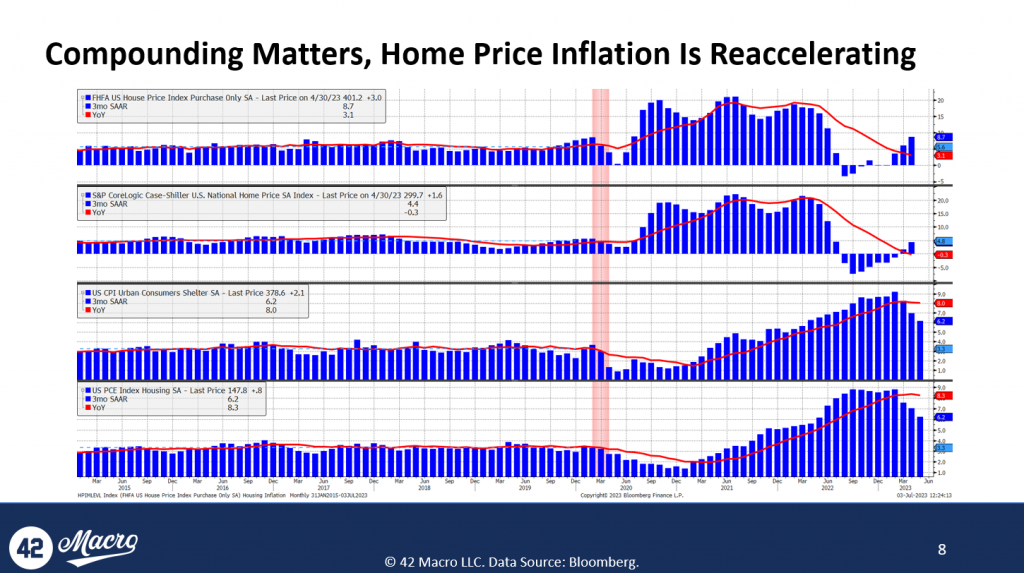
4. Home Prices Are Reaccelerating
According to the FHFA home prices index, home prices are increasing at a rate of 8.7% on a three-month annualized basis after bottoming in the first half of the year.
There is a rising probability we will see housing inflation bottoming out in the next two to three quarters, but at levels that contradict the Fed’s 2% inflation mandate.
The implications of this trend could be concerning, as the Fed might need to do significantly more to counteract the inflation impulse from the housing market.
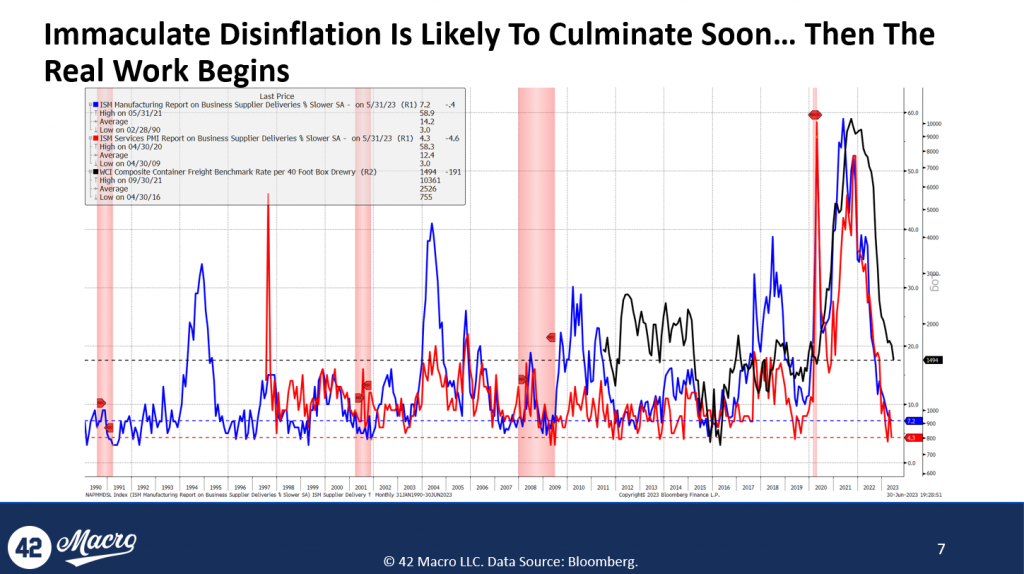
5. The Days of Immaculate Disinflation Are Over
Indices like ISM manufacturing, ISM services, and the supply delivery times index are back at levels consistent with 2% inflation, implying that the period of “immaculate disinflation” driven by pandemic-related factors is coming to an end.
We believe that the easy part of the inflation battle might be over soon.
That’s a wrap!
If you found this thread helpful, go to www.42macro.com/appearances to unlock actionable, hedge-fund caliber investment insights.
Macro Outlook
Darius joined Benjamin Cowen from Into The Cryptoverse earlier this week to discuss Inflation, the Labor, Liquidity, and more.
If you missed the interview, we have you covered. Here are three key insights that are important for your portfolio:
1) Despite The Recent Dovish Print on Inflation, We Believe The Fed Will Hike At The July Meeting
The money markets are currently pricing in approximately an 80% probability that the Federal Reserve will hike at their next meeting.
Generally, the Fed tends to move in sync with asset markets, acting according to what the market has priced in.
However, the Fed’s decisions are not purely inflation-oriented; they take into account labor market conditions as well.
Given these indicators, we believe the Fed will likely push through with the rate hike come July’s meeting.
2) Labor Hoarding Is Contributing to The Resiliency of The U.S. Economy
While the US Total Labor Force SA is trailing behind the pre-pandemic 2009-2019 trend, we have seen the Gross Domestic Income regain the trend shortly after the pandemic concluded.
This disparity tells us that there is an abundance of money in the economy but an inadequate labor force to meet the demand for goods and services.
Additionally, since March 2020, we have experienced labor demand outpace supply, with a staggering 3.9 million more in demand compared to available labor.
This excess demand for labor is causing labor hoarding, further strengthening the resilience of the U.S. economy.
3) We Are In A Liquidity Cycle Upturn; The Global Liquidity Cycle Bottomed In Fall of Last Year
Our 42 Macro Global Liquidity proxy, a sum of global central bank balance sheets, global broad money supply, and global FX reserves minus gold, shows a declining trend in recent months.
However, we believe the liquidity cycle bottomed last fall, and we are currently in the midst of a likely 2.5-year upswing.
Although we may see some turbulence over the next few quarters, Bitcoin, in this environment, could perform exceptionally well, pushing it above the $100,000 level by the end of next year.
In between now and then, we still anticipate a recession will commence in the US economy in the next two to three quarters, likely causing risk assets to fall as the Phase 2 credit cycle downturn sets in – a scenario that we believe has not been priced into the market yet.
We continue to believe risk assets will squeeze higher and peak in Q4 or Q1 of next year.
#respectthexaxis
That’s a wrap!
If you found this thread helpful, go to www.42macro.com/appearances to unlock actionable, hedge-fund caliber investment insights and have a great day!
What’s Propping Up The US Consumer?
Last week, Darius joined Maggie Lake from Real Vision to discuss Rate Hikes, Inflation, the Stock Market, and more.
In case you missed it, here are five takeaways from the interview every investor needs to know:
1) The Market Believes The Fed Is Done Hiking. We Are Fading That View.
Currently, money markets are pricing in the assumption that future inflation data will force the Fed to pause at their July meeting.
Moreover, money markets are pricing in twice as much easing over the next two years by the Fed as they are the ECB (Fed: ~200 basis points; ECB: ~100 basis points)
We believe this is unlikely because 1) the European economy is already in recession, and 2) the European inflation cycle tends to lag the US by two quarters; as a result, they are heading into the most disinflationary part of their Inflation Cycle in 2H23.
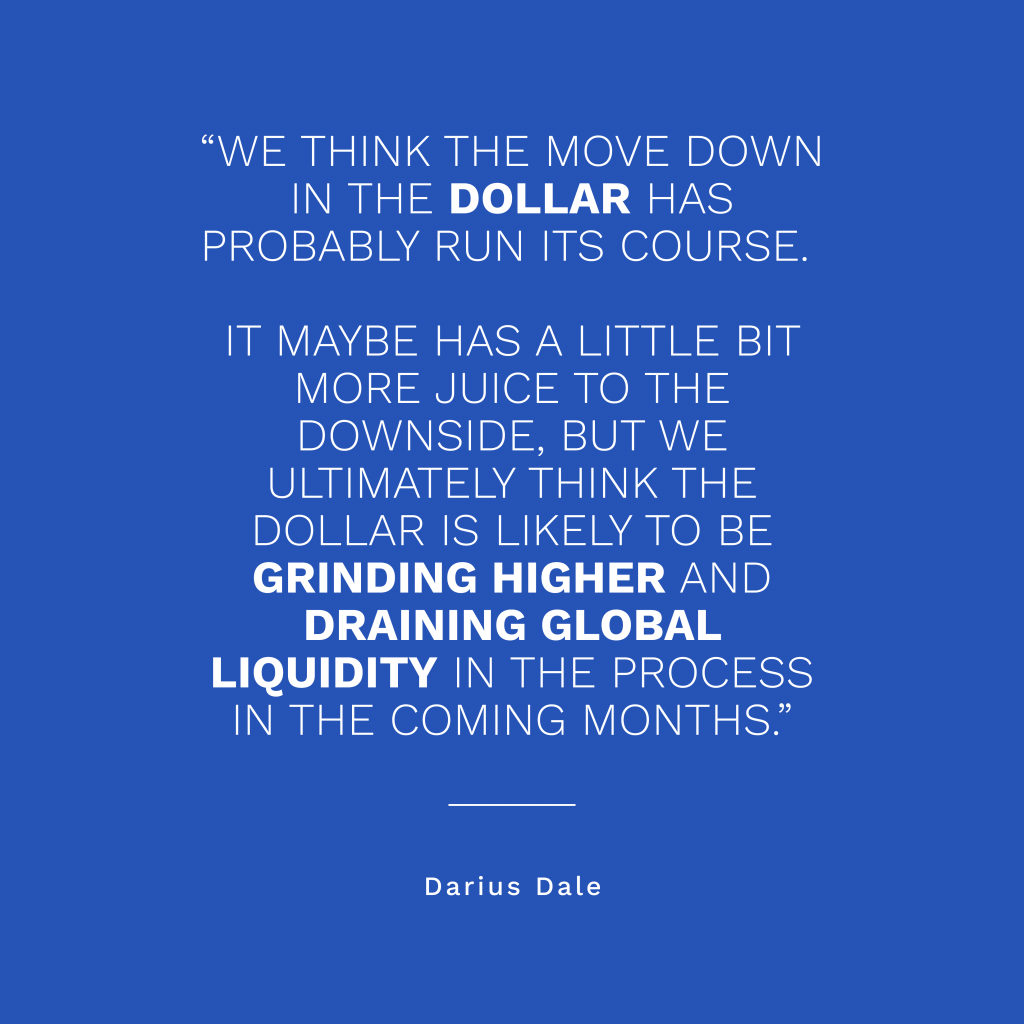
While it may not occur in July due to a likely dovish June CPI release, we expect the Fed to continue to raise rates in the coming months.
Consequently, we foresee the dollar grinding higher over the medium term.
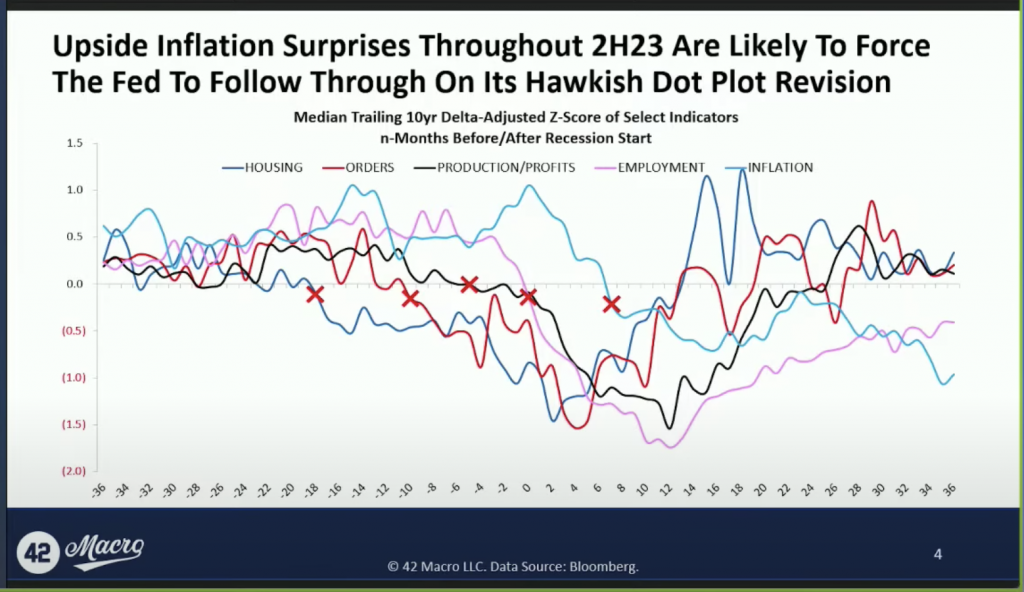
2) We Expect A Series of Upside Inflation Surprises Throughout 2023
Throughout the year, erroneous forecasts have caused investor consensus to roll forward the recession starting point; now, consensus estimates call for the recession to begin in Q3.
However, inflation tends to break down 6-8 months after the recession starts – it is the most lagging indicator of the US Business Cycle.
As a result, we believe we will not see any further significant disinflation after the June CPI release without a substantial drawdown in the labor market.
3) A Variety of Factors Are Propping Up The Consumer
We are seeing a wide range of conditions still propping up the US consumer:
- Unemployment is still low; the booming US labor market has allowed consumers to continue spending
- Cash on household and corporate balance sheets is high, currently at 3% of total assets. The last time that ratio was that high was in the 1960s
- Manufacturing as a % of GDP has declined substantially in recent decades. That is important because manufacturing tends to account for 98% of total job loss during recessions. Now only 18% of GDP, this more volatile sector of the economy is a much smaller percentage of total employment too at only 14%.
- Housing is resilient; despite the interest rate increases, outstanding mortgage rate debt is still at 3%. There is a standstill in existing home sales because consumers will not trade lower mortgage rates for the higher current rates – this has increased demand for new homes, thus holding up the housing market.
4) The Phase 2 Credit Cycle Downturn Is Ahead of Us
We believe the recession is still ahead of us.
Since the Great Depression, EVERY recession has had a market crash associated with it as we price in the downturn in the credit cycle.
In addition, on a median basis, markets tend to peak a month before the lowest point in the unemployment rate.
So, we typically see degradation in the labor market and a dip in the stock market simultaneously.
That means investors who share our longer-term (6-12mos) bearish outlook for the stock market must avoid expressing that view with actual trades until we are much closer to the start of recession. Since last fall, we have identified 4Q23 as the quarter with the highest probability of seeing a recession commence in the US economy. The second highest probability is 1Q24.
5) The Stock Market Is Likely Nearing A Local Top
This stock market rally has caught many investors off-guard; most fund managers are hastily rushing to minimize their YTD underperformance.
As a result, the rally can largely be explained by investors chasing the market higher, further squeezing Bears.
Despite the recent uptrend, we advise against chasing stocks now.
We expect a correction in the near term for a variety of fundamental (e.g., declining US and global liquidity) and technical (e.g., the passage of a large, call-heavy OPEX should reverse flows) reasons.
That’s a wrap!
If you found this thread helpful, go to www.42macro.com/macro-bundle to unlock actionable, hedge-fund caliber investment insights and have a great day!
Macro Indicators and Tactics for Uncertain Times
1) The US Economy Remains on a Path to a Recession
At the beginning of the year, most investors expected a first-half recession followed by a recovery in the second half.
Since last summer, our view has consistently been that the U.S. economy had more endurance than what was perceived by most investors.
This belief led us to forecast a later start to the recession, in late-2023, contrary to the general market consensus.
Our view was, and still is, that a recession would likely kick off in Q4 of this year or Q1 of next year.
2) Inflation Will Not Reach 2% Without a Recession
U.S. inflation, a lagging business cycle indicator, usually breaks down during and through a recession.
Our data suggests that it’s improbable we will see evidence of sustainable 2% inflation before a recession hits: our models currently forecast inflation stabilizing at around 3-5%, not the Fed’s 2% target.
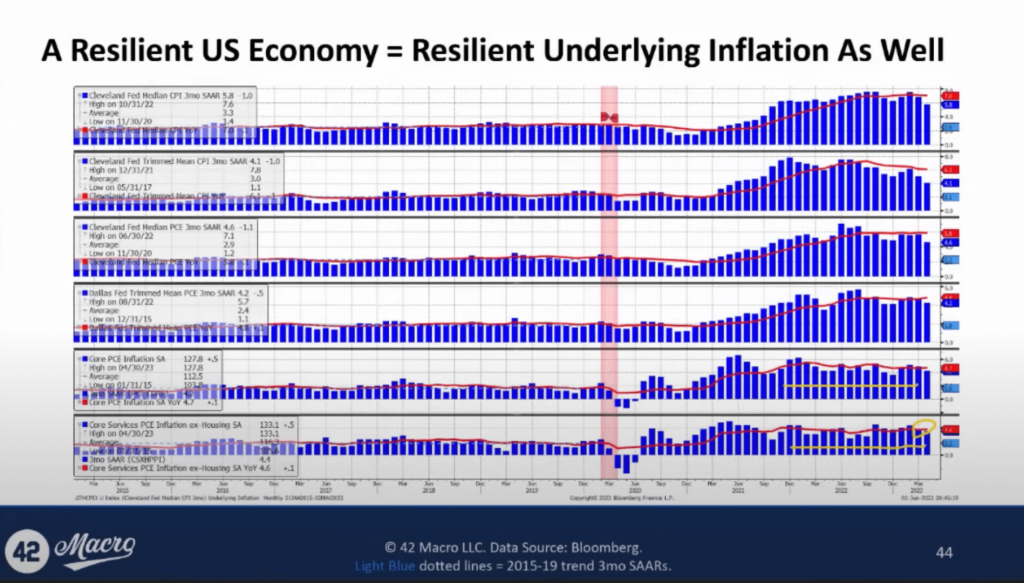
This could lead to two potential outcomes: either the Fed acknowledges more action is needed, or the bond market panics over the lack of progress.
Either way, we believe it will result in the Fed applying more pressure, pushing the economy into recession.
3) Europe’s Economic Contraction Will Likely Worsen
The European economy has recently confirmed its recession, primarily due to the effects of monetary tightening.
Despite the assumptions that fiscal stimulus would resolve the situation, Europe’s economy is in decline, with retail sales tracking down 2% to 4% across Europe.
Given the current data, we predict the recession in Europe is likely to worsen over the medium term.
4) Upcoming Quantitative Tightening Will Negatively Impact Asset Markets
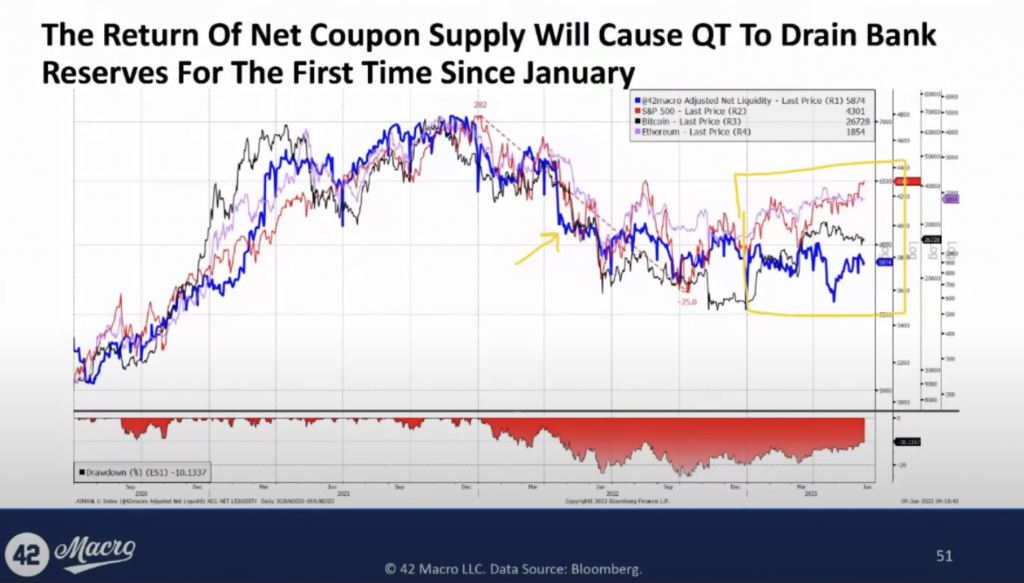
The return of net coupon supply will instigate QT, causing it to deplete bank reserves for the first time since January.
Our Adjusted Net Liquidity model, which subtracts the Treasury General Account (TGA) balance and Reverse Repo Facility (RRP) balance, as well as emergency lending from the Fed’s balance sheet, shows a breakdown in the correlation between US public sector liquidity and asset markets at the beginning of the year when QT ceased draining bank reserves.
Up until now, QT has truly been going on in the background.
We believe this correlation will resume in the coming months and negatively affect risk assets.
5) The Stock Market Is Likely To Peak During Q4 (or Early In Q1 At The Latest)
Our study of past recessions shows that the stock market, on a median basis, typically peaks a month before the trough in the unemployment rate.
Historically, the stock market usually rises sharply in the year leading up to the end of a business cycle, with a median return of around +16%.
Equity markets are generally strong preceding a recession.
We maintain the view that the stock market will likely peak in Q4 (or early in Q1 at the latest) and many of today’s too-early bears will fail to profit from the pending Phase 2 Credit Cycle downturn.
At that point, we will be positioning for the next anticipated down leg in the market.
That’s a wrap!
If you found this thread helpful, go to www.42macro.com/macro-bundle to unlock actionable, hedge-fund caliber investment insights and have a great day!
Global Liquidity Decoded
1. China and Japan are Important to the Global Liquidity Cycle:
China and Japan are key contributors to the global liquidity cycle.
Regarding their contributions to the global central bank balance sheet, global narrow money supply, and global FX reserves minus gold – the three metrics that we feature in the @42Macro Global Liquidity Proxy – China makes up ~20%, while Japan makes up ~15%. Understanding their liquidity cycles is vital in forecasting inflections in global liquidity.
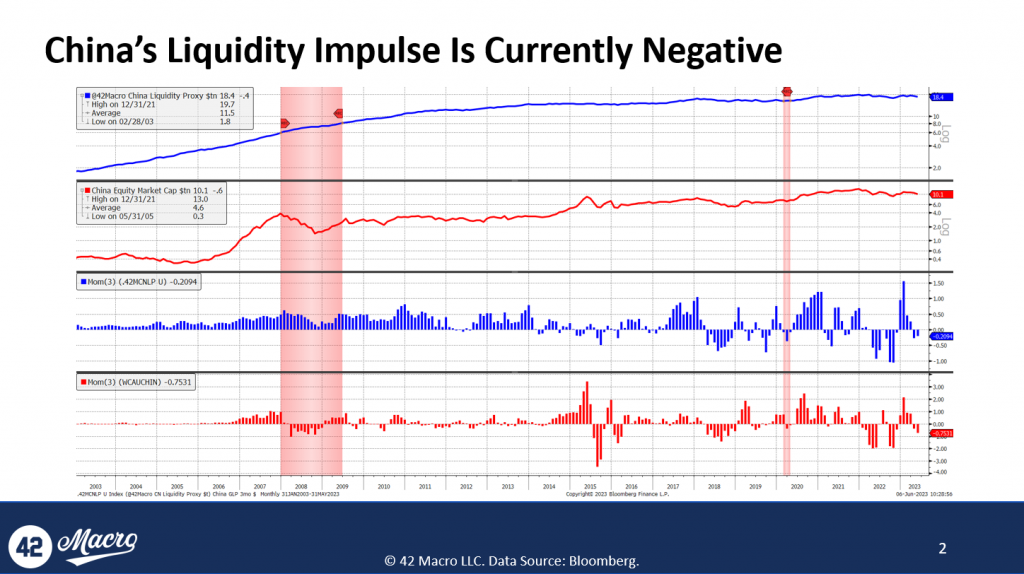
2. The Chinese Liquidity Cycle Has a Big Impact on Asset Markets:
There’s a direct link between China’s liquidity and the global markets, including Bitcoin. Any significant shift in China’s liquidity, positive or negative, can considerably affect asset markets.
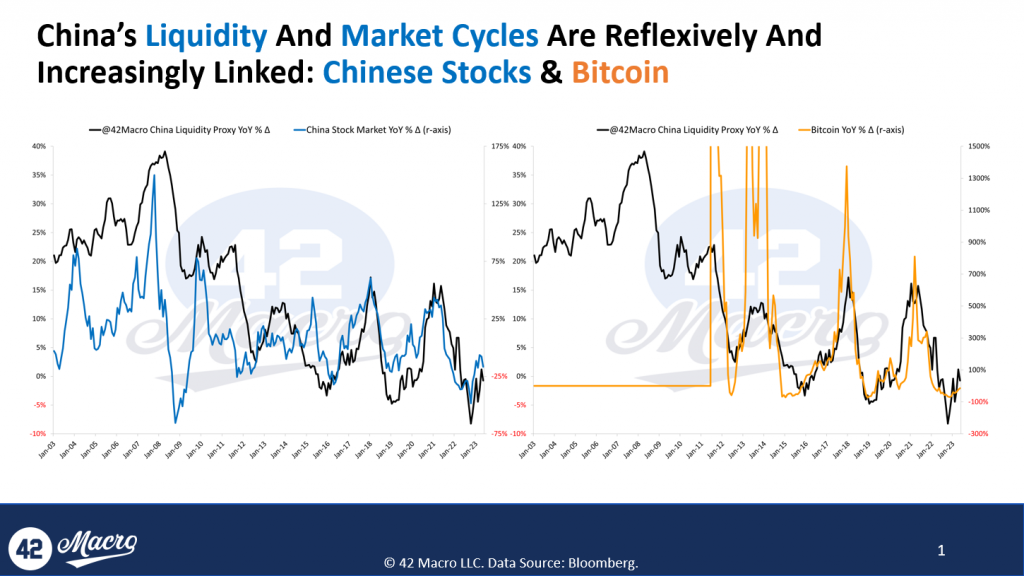
Our research shows that the Chinese economy shifted from adding approximately $1.5 trillion of liquidity in Q1 of this year to removing liquidity in the past few months. The pullback in Chinese liquidity coincides with #Bitcoin failing to continue its rally. We believe we will see another injection of liquidity into the Chinese economy; we just don’t believe it will happen in the short term.
3. Waning Public Sector Liquidity Provision in China:
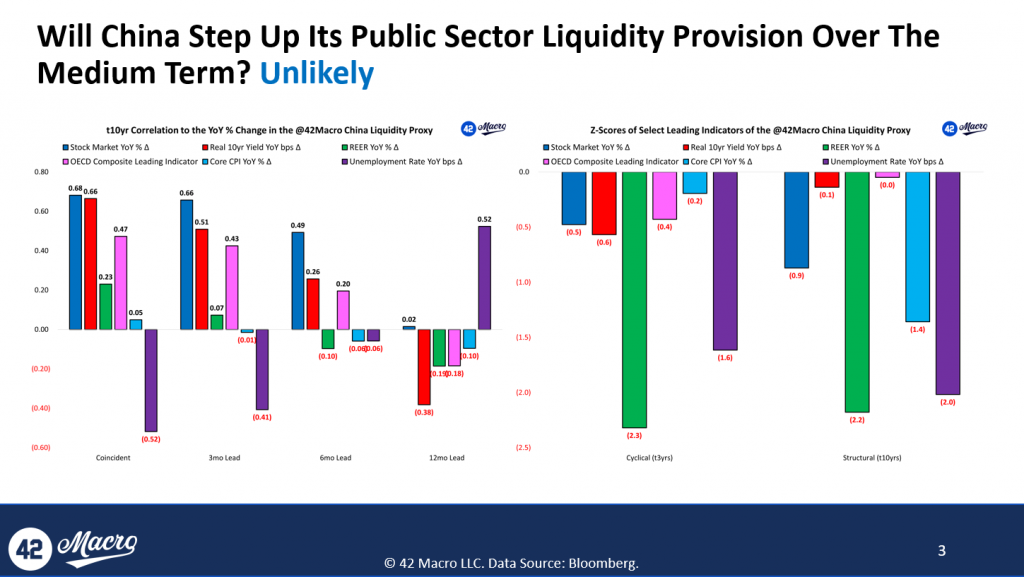
The Chinese stock market is viewed as a reliable leading indicator of the country’s liquidity cycle because locals often have intelligence regarding future actions of the People’s Bank of China (PBOC).
We believe the recent decline in the Chinese stock market likely signals a decrease in China’s contributions to global liquidity over the medium term (because the market doesn’t anticipate a wave of liquidity from the PBOC).
4. Japan’s Liquidity Cycle Influences Bitcoin Too:
Like China, Japan’s liquidity cycle strongly correlates with Bitcoin and other risk assets.
Our research shows that in October of last year, the Japanese economy was removing $1.5 trillion from global liquidity on a three-month impulse basis.
In Q1 of this year, they shifted to add $2 trillion.
Because inflation is still very high in Japan, we do not foresee a liquidity injection from the BOJ in the near term.
5. It’s Not Just Enough to Monitor Global Liquidity; You Must Forecast It As Well:
The timeline for changes in liquidity inputs to manifest in outputs (values or liquidity changes) varies by the economy.
When an economy is at the bottom of its growth cycle (e.g., unemployment rising on a YoY basis, etc.), lead times are usually shorter because central banks will react with a sense of urgency to support their economies.
Conversely, factors like stock market performance and real interest rates in China may not trigger a similar sense of urgency by the PBOC and/or Chinese commercial banks.
Overall, the objective is to understand these dynamics to forecast the global liquidity impulse, which is currently negative. We believe this negative impulse is the reason Bitcoin hasn’t fully recovered its YTD high.
That’s a wrap!
If you found this thread helpful:
- Go to https://42macro.com/appearances to unlock actionable, hedge-fund caliber investment insights and have a great day!
Whose portfolios are at risk over the next six months? The bulls or the bears?
1) The Bond markets are pricing in significant Federal Reserve easing in the coming 12-18 months.
In addition, the Fed Funds futures show easing is likely to start as early as November of this year.
But, our view on liquidity and factors in the real economy show that market positioning should change over the medium term.
As a result, we expect to see an increase in bond market volatility over the next quarter or two before we get into a recession.
2) The US consumer has been resilient.
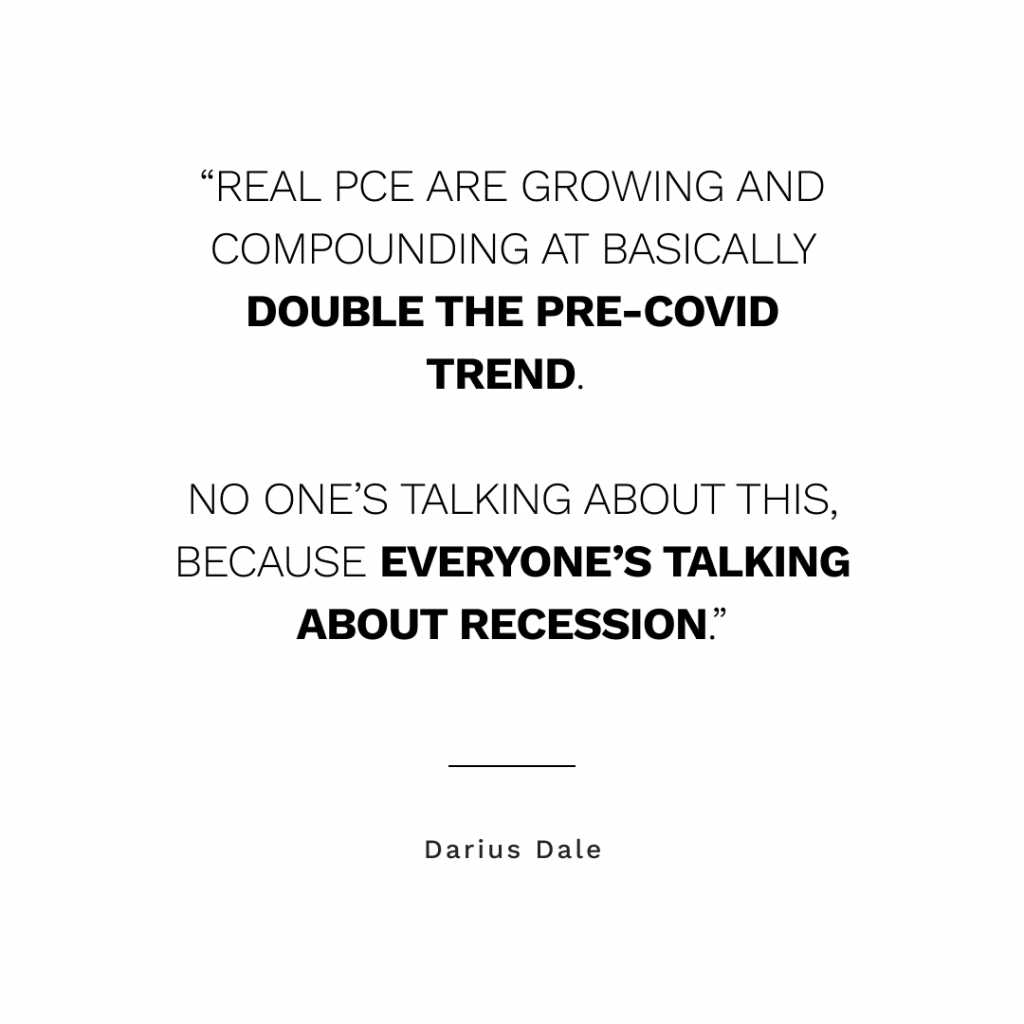
Real PCE, which measures the value of goods and services purchased by households in the US, adjusted for inflation, is growing at twice its pre-covid trend.
Real Income is also growing at a three-month annualized rate of 7.6%.
The uptick in real PCE and Income signals increased demand for goods and services. This increase in demand can lead to higher prices, causing inflation to persist.
So, a resilient US consumer means sticky inflation.
3) The recession is likely to be delayed relative to investor consensus.
Many investors have been calling for a recession for over a year.
On top of that, many analysts are predicting negative GDP growth in the second quarter of the year.
But, our research shows the economy is resilient and will likely stay resilient until at least Q4.
And this delay could trap both bulls and bears, leading to significant volatility in both the stock and bond markets.
4) The AI bubble will eventually meet the wrong part of the Liquidity cycle.
The rise of AI is similar to the internet boom in the early 2000s. We could see a similar blow-off top in late-2023.
And while emerging technologies bring about significant societal changes, they don’t prevent market downturns. Investors would be wise to sell into strength later this year.
5) Is the bad news priced in? Are markets forward-looking?
We’ve backtested asset markets extensively and found that markets only look 2-3 months ahead at most.
Despite what people think, markets are more reactive than predictive.
And they’re most reactive to changing liquidity conditions. Since 2009, equity markets have been highly correlated to global liquidity.
Liquidity drives markets, and we believe the recovery in liquidity might not be as linear as many investors believe.
6) We expect a negative liquidity backdrop over the next few months.
We’ve probably seen a medium-term high in liquidity.
The expected increase in the Treasury General Account and the return to net coupon issuance by the US Treasury are negative for liquidity.
As a result, the Dollar could trend higher in the near term, harming #Bitcoin and other risk assets.
That’s a wrap!
If you found this article helpful, go to https://42macro.com/macro-bundle to unlock actionable, hedge-fund caliber investment insights.
Have a great day
Rough Summer Ahead?
We joined Anthony Pompliano earlier this week to discuss the Debt Ceiling, Recession, Global Liquidity, and more.
Every investor will want to review the following six highlights from the interview:
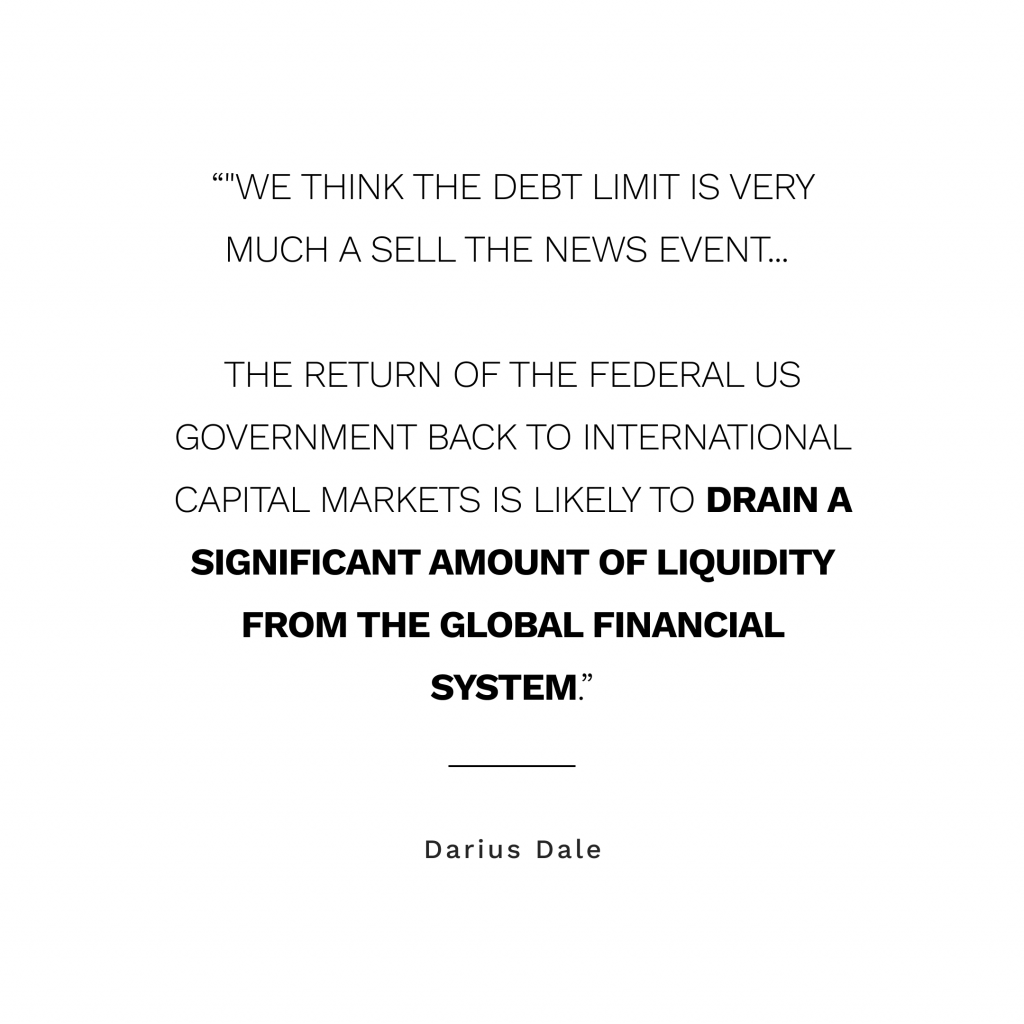
1. We expect the Debt Limit Crisis to negatively impact global liquidity.
The US government will return to the international capital markets to borrow more money (after resolving the crisis).
When that happens, a material amount of liquidity will be removed from the system, driving asset prices down.
2. Understanding the Treasury General Account Balance
The Treasury General Account Balance, essentially the checking account of the US federal government, is a crucial component of global liquidity.
When this balance decreases, it signifies that the government is spending more, increasing liquidity in the economy.
The TGA has declined for the past few quarters, supporting global liquidity and risk assets.
We anticipate a significant increase in TGA in the coming months, which will drain liquidity from the private sector.
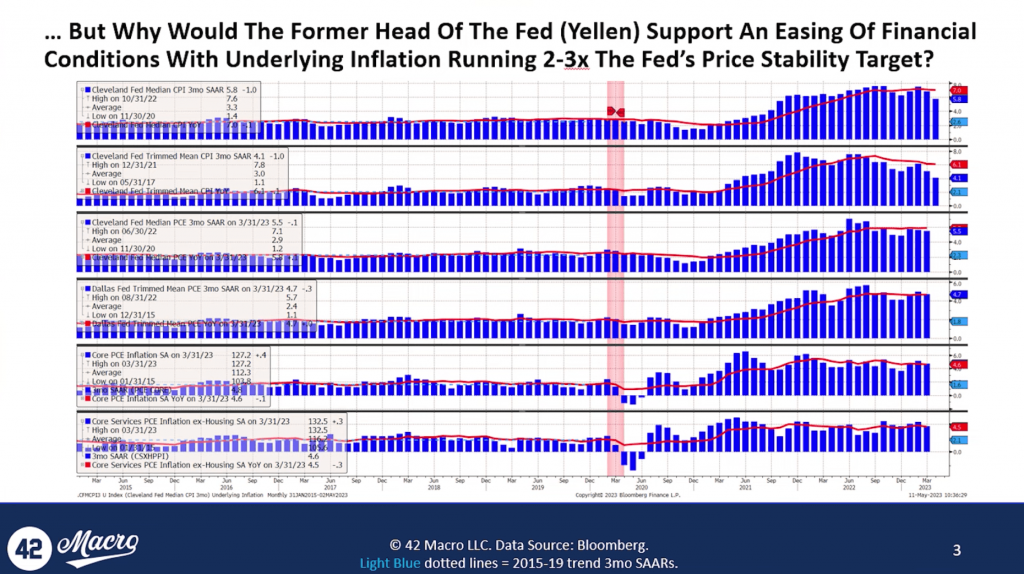
3. Inflation is running at 2-3 times the Federal Reserve’s price stability target.
Given current inflation rates, it doesn’t make sense for Secretary Yellen to support financial easing by flooding the market with T-bills.
Easing financial conditions would drive asset markets higher, only making inflation worse.
4. The Impact of the Inverted Yield Curve
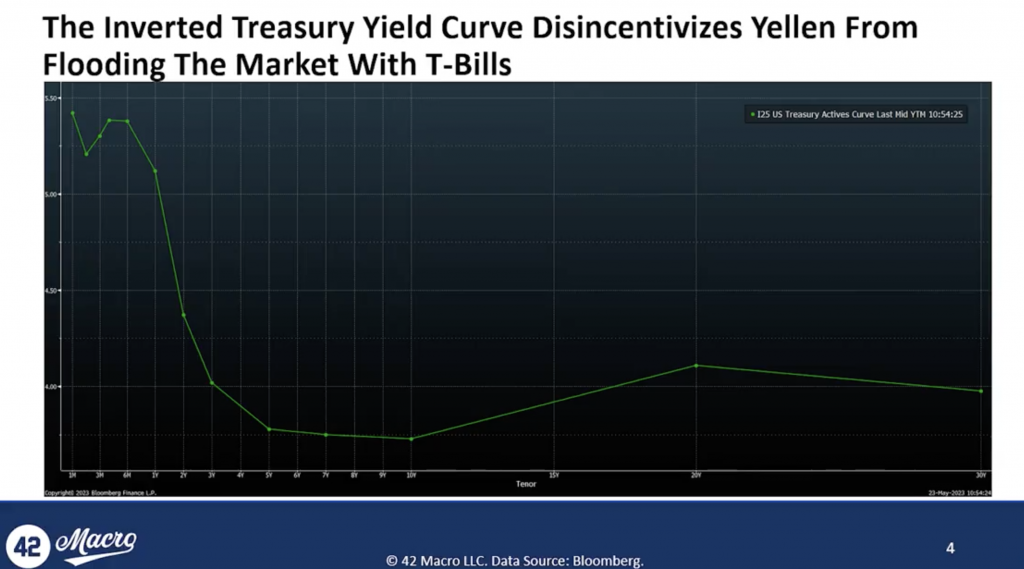
An inverted yield curve occurs when short-term debt instruments (like T-bills) have a higher yield than long-term debt. It’s often seen as a predictor of an upcoming recession.
Because the Treasury needs to pay interest on issued debt, they are incentivized to lock in the lowest rates, which are currently notes maturing in the 3-10 year range.
This is another reason we believe Secretary Yellen is unlikely to flood the market with T-bills, supporting our view of lower asset prices in the quarters ahead.
5. Changes in Global Central Bank Policies
Global Central Banks also have massive implications for global liquidity and, therefore, asset markets.
We foresee another headwind for asset markets:
The two central banks responsible for the improvement in global liquidity the most over the past year, the People’s Bank of China (PBOC) and the Bank of Japan (BOJ), have been draining liquidity over the past quarter (on a trailing 3-month impulse basis).
The impulses take time to flow through financial markets, but we expect the actions of the PBOC and BOJ are likely to serve as a headwind for risk assets in short order.
6. Potential for a Rough Summer
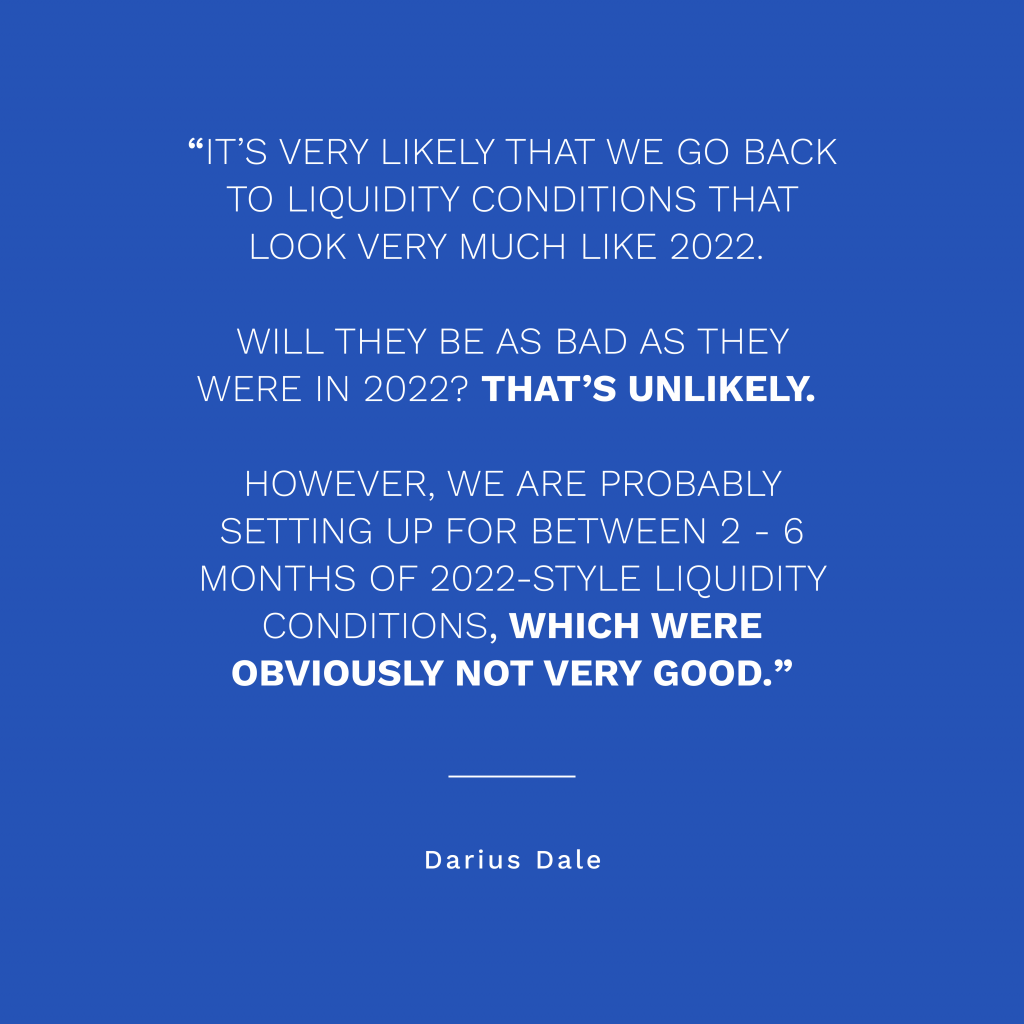
We expect a shift in liquidity conditions from a very positive trailing six months to a more challenging period over the next two to four months.
The actions of the Fed, Treasury, and Foreign Central Banks over the next 1-2 quarters are not supportive of a positive liquidity environment.
Our advice to you is: if you are invested in risk assets, be careful.
That’s a wrap!
If you found this thread helpful:
1. Go to https://42macro.com/macro-bundle to unlock actionable, hedge-fund caliber investment insights
2. Have a great day!