In the event a Market Regime phase transition takes place, it may impact one or more of the Target Allocations for the VT, GLDM, and FBTC positions in KISS per the Top-Down Risk Management Overlay. Any changes will also impact the Actual Exposures for the corresponding positions per the Bottom-Up Risk Management Overlay.
In the event a Volatility-Adjusted Momentum Signal (VAMS) phase transition takes place for the VT, GLDM, or FBTC ETFs, it will impact the Actual Exposure for the corresponding position per the Bottom-Up Risk Management Overlay.
If you are implementing a customized version of KISS Model Portfolio, the Top-Down Risk Management Overlay logic still applies to each asset class. You will note any change in the Market Regime at the top of the Discretionary Risk Management Overlay table.
If you are implementing a customized version of KISS Model Portfolio, the Bottom-Up Risk Management Overlay logic still applies to each position. You will find any changes in the Volatility-Adjusted Momentum Signal of the ETFs you have diversified into in the VAMS columns of the table.
Please note that the Proper Trade signals in the Discretionary Risk Management Overlay do NOT correspond to KISS Model Portfolio. They are only there for investors who have declined to implement the standard KISS Model Portfolio — i.e., the institutional investors among the members of our global investor community, as well as the retail and RIA investors who believe they can outperform KISS Model Portfolio with their own investment process. We are happy to support them either way.
Because asset markets typically “take the stairs up and the elevator down,” a good rule of thumb is to be patient when increasing positions and be in a hurry when reducing positions. That is how 42 Macro Founder and CEO responds to KISS Model Portfolio Actual Exposure pivots in his portfolio.
When building positions, the strategy employed by 42 Macro Founder and CEO Darius Dale is to fill a particular position in two tranches over two weeks. The goal is to wait patiently for a meaningful down day each week, which buy limit orders help facilitate. If there are no meaningful down days, then Darius executes his buy orders on Friday.
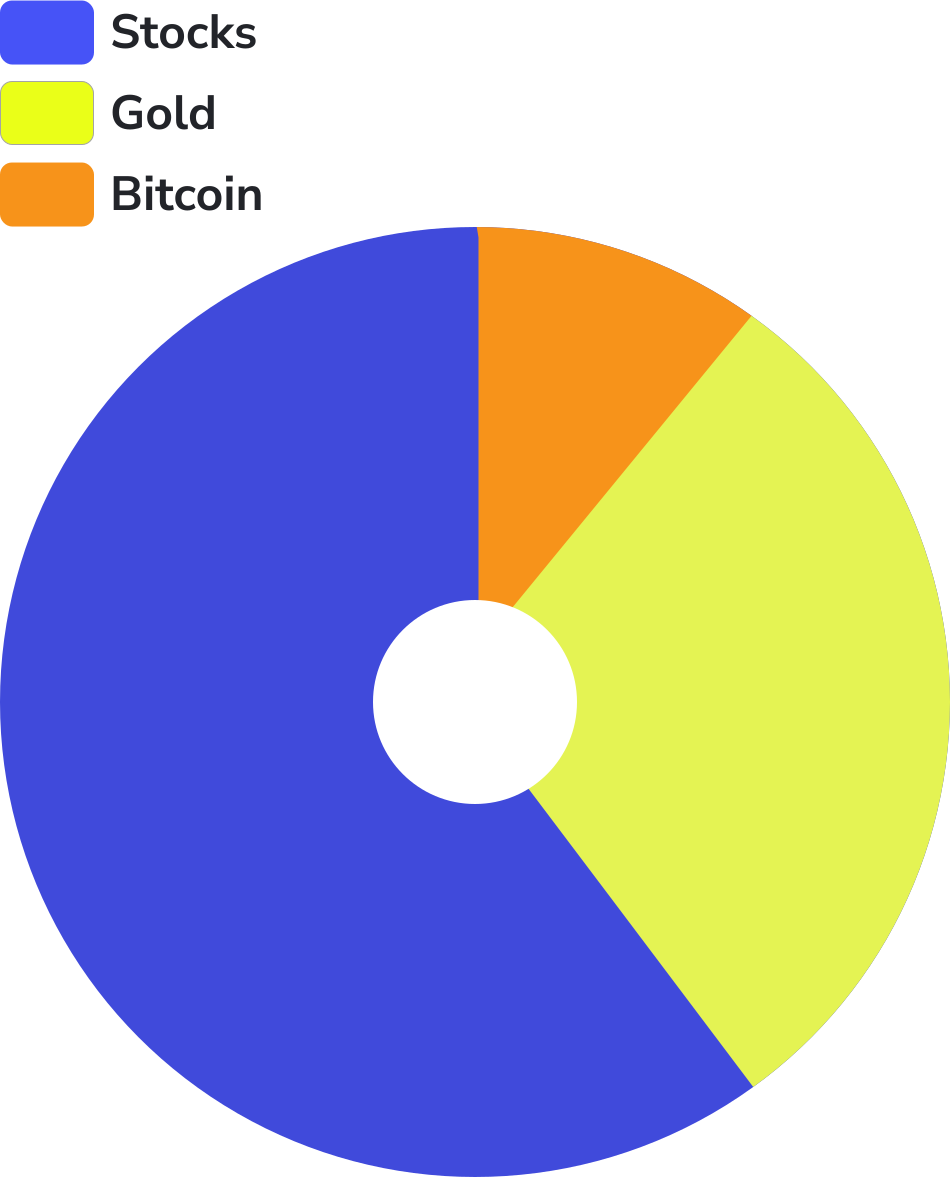
Darius’ DCA strategy would build a 60% position in VT over two weeks via two 3,000bps purchases.
Darius’ DCA strategy would build a 30% position in GLDM over two weeks via two 1,500bps purchases.
Darius’ DCA strategy would build a 10% position in FBTC over two weeks via two 500bps purchases.
Please note that we do not recommend a specific speed for dollar-cost averaging. Again, the speed with which an investor should dollar-cost average depends on two highly personalized factors: 1) the bandwidth a particular investor might have to execute trades; and 2) their unique susceptibility to Myopic Loss Aversion, or sensitivity to short-term unrealized losses.
Each DIY investor must use trial and error to determine what dollar-cost averaging speed works best for them and their unique susceptibility to Myopic Loss Aversion.